Alice Springs Town Council welcomes community members to attend and observe during the open part of Ordinary Council meetings, and to participate during public question time.
To ensure meetings are conducted efficiently and respectfully, attendance and participation are subject to the requirements outlined below.
Conduct
The following standards of conduct apply to all attendees in the public gallery:
- Do not disrupt the meeting or engage in disorderly conduct, including booing, heckling, interjecting or making loud comments.
- Follow any directions given by the Mayor or Council staff.
- Do not approach or engage Council Members during the meeting.
- Ensure mobile phones and other electronic devices are switched off, or set to silent.
- Do not bring signs, placards or banners into the public gallery.
- Do not make audio, video or photographic recordings of the meeting, including by mobile phone or live streaming, without prior Council approval.
- Food and drink are not permitted.
The Mayor may adjourn the meeting or direct the removal of any person whose behaviour disrupts the orderly conduct of the meeting.
By attending an Ordinary Council meeting, you acknowledge that open Council meetings are livestreamed and that your image and voice may be broadcast to the public. Alice Springs Town Council accepts no liability for any defamatory remarks that are made during a meeting.
Attendance is subject to venue capacity limits, with available seating allocated on a first-come, first-served basis.
Public Questions
At each Ordinary Council meeting, during the ‘Public Questions, Petitions and Deputations’ section, members of the public may address questions to Council relating to an item on the agenda or other Council business. This ensures transparency and provides a direct avenue for community concerns to be addressed in a public forum.
Questions may be asked at the meeting or submitted in writing beforehand using the form below. Council encourages questions to be submitted in advance wherever possible, as this provides the greatest opportunity for a considered response to be provided during the meeting. Written public questions must be submitted at least seven calendar days before an Ordinary Council Meeting to be included. Questions received after this deadline will be carried forward to the next scheduled Ordinary Council Meeting.
- Questions must relate to the functions or responsibilities of local government.
- Questions must not take the form of a statement.
- Debate or discussion on a response is not permitted.
- Name and address must be provided.
- A member of the public may speak for no longer than five minutes.
- Responses will only be provided by the Mayor, or if delegated, by the CEO or a Director.
Council will endeavour to respond to questions during the meeting. Where this is not possible, the question may be taken on notice and a response provided after the meeting.
Council may refuse to accept a question where it:
- is offensive, inappropriate or defamatory
- reflects adversely on Council without a proper basis
- does not relate to a matter within Council's responsibilities, or
- substantially repeats a question asked within the previous three months.
Where a question is not accepted, the questioner will be advised of the reason.
Petitions
Formal petitions allow groups of residents to collectively bring an issue or request to Council’s attention.
Petitions must:
- be in writing
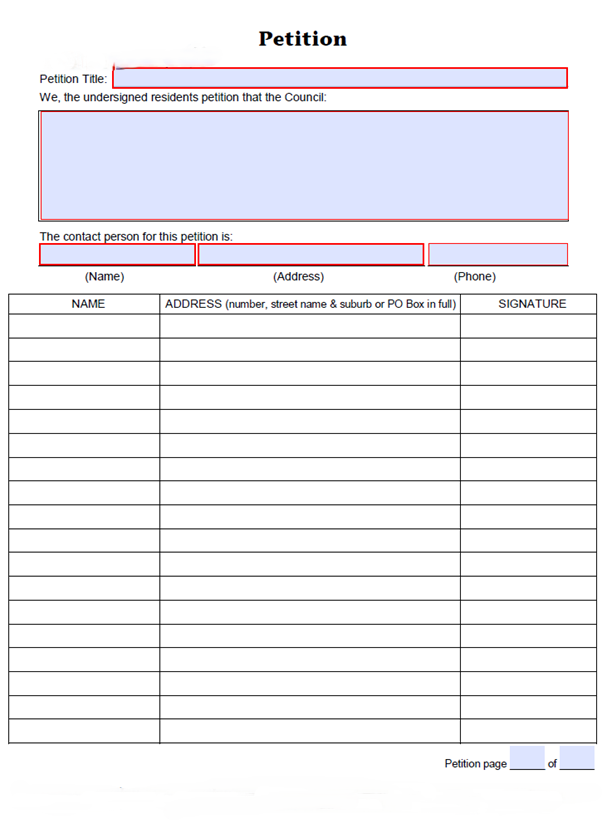
- include the names, addresses, and signatures of supporters
- be received from residents, ratepayers or electors of the Alice Springs municipality, and
- relate to a matter on which Council has the power to act.
To be considered, a petition must be provided directly to a Council Member, who may choose to present the petition to an Ordinary Council meeting.
A Council Member who is bringing a petition to an Ordinary Council meeting must provide the petition to the CEO at least seven calendar days before a meeting for inclusion on the agenda.
At the meeting, the Council Member bringing the petition to Council must state the nature of the petition and read the petition in full.
No debate on or for the petition is to take place. Petitioners are welcome to attend the meeting, however, they cannot ask questions or present the petition.
The petition can be in electronic or paper format, provided it meets the following requirements:
- The reason for the petition is stated clearly and in plain language; if paper format this must be clearly displayed at the top of each page.
- A main contact name and contact details (address and email) are provided, to enable follow up from Council.
- The name, address and signature for each signatory.
- The petition does not contain any language or subject matter that is disrespectful or likely to be considered defamatory to any person.
- A petition may be presented to a meeting by a member who, before presenting the petition, shall, as far as practicable, become acquainted with the subject matter of the petition.
Personal information included in petitions will not be made publicly available.
Elected Member contact details can be found here.
Petitions can be in any format, but the basic information that should be included is detailed below: